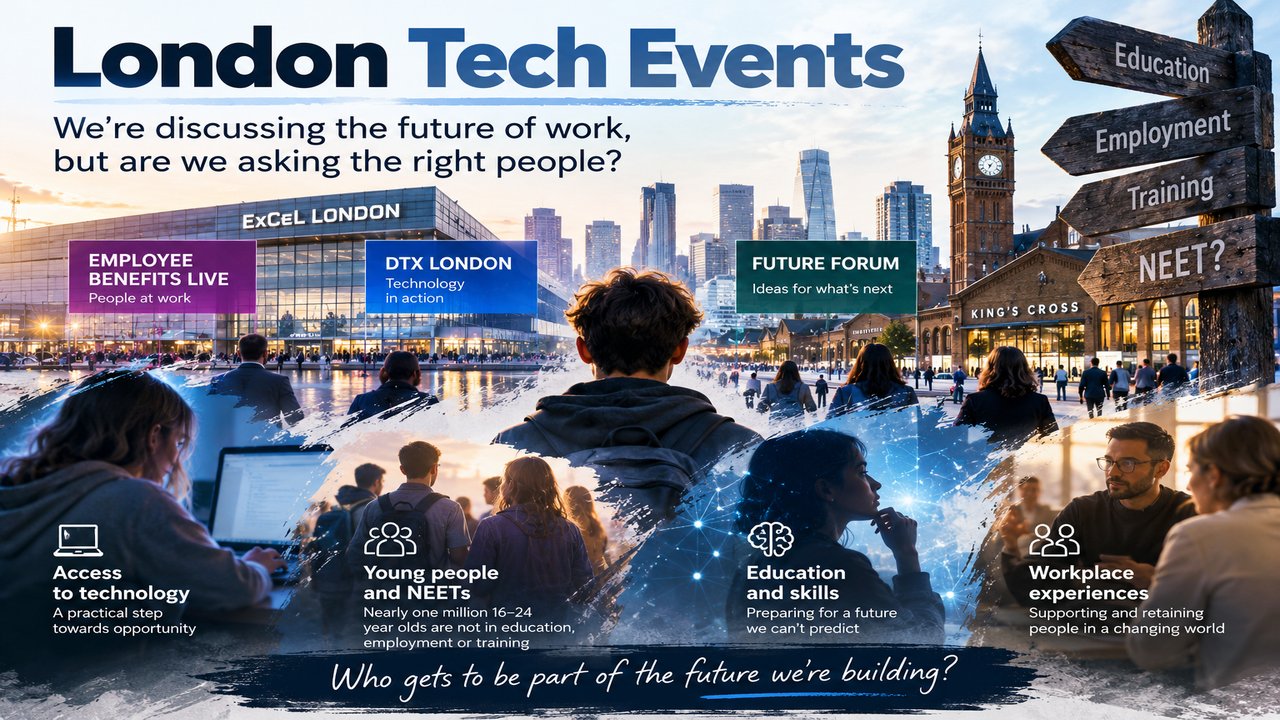
We’re discussing the future of work, but are we asking the right people?
Last week, between 13 and 15 October 2026, I attended three London events: Employee Benefits Live, Digital Transformation EXPO (DTX) and Future Forum. Each approached technology and the workplace from a different perspective, yet together they raised questions about opportunity, access and who gets a voice in shaping the future.
It was also Women in Tech Week, which ran from 12 to 16 October with more than 100 free events across the UK. I didn’t manage to get to many of them, as many were sold out. [1]
Employee Benefits Live and DTX combined tech and the workplace and Future Forum brought together people from education, business, technology and others to explore how AI might change society and the workplace. [2][3][4]
There was plenty to think about, but two experiences stood out: a discussion about the jobs of tomorrow and a conversation with a charity giving unwanted office technology a second life.
Future Forum: Who are we preparing for the jobs of tomorrow?
Jobs of Tomorrow, moderated by Edie Lush, with Dr Sharmla Chetty, Ed Fidoe, Rushma Khan and Joe Seddon, was a particularly strong session.
The panel explored the relationship between AI, education, skills and the changing nature of employment. Rather than treating the future of work as a matter of predicting which jobs will disappear or emerge, the discussion considered how education and opportunities might adapt to a world that is becoming harder to predict. [5]
For decades, young people have been encouraged to follow a recognisable route through school, qualifications, further education and employment. That route still works for many, but what happens when industries change faster than educational pathways, or when the skills employers expect are themselves evolving?
AI adds another dimension. We can use it to support learning, explore career possibilities and develop new ways of working, yet access to those opportunities depends on more than having the technology available.
It depends on confidence, circumstances, support, experience and whether people can see a realistic route forward? What about the young people who are already outside the traditional routes into employment. If we’re designing education for the jobs of tomorrow, where do those young people fit?
The NEET question: Nearly one million young people
In August 2026, the Office for National Statistics reported that an estimated 981,000 young people aged 16 to 24 in the UK were not in education, employment or training (NEET) during April to June 2026. That represented 13% of the age group. [6]
It’s a substantial number, but the headline doesn’t tell us why those young people are in that position.
The ONS estimates included approximately 393,000 unemployed young people who were NEET and 588,000 who were economically inactive. These are different circumstances, and the statistics need to be interpreted accordingly. [6]
Some young people may face health difficulties or caring responsibilities. Others may be navigating limited opportunities, unsuitable education pathways or barriers to accessing employment. Being NEET does not describe someone’s ambitions, capabilities or willingness to participate. It describes their current position in relation to education, employment and training.
We can design new qualifications, create AI training programmes and encourage people towards emerging careers, but what happens if we don’t understand the barriers preventing them from participating in the first place?
A programme designed around an assumed lack of skills may miss a problem involving access, confidence, circumstances or opportunity, and how much of the discussion about future employment is shaped by the experiences of people who successfully navigated the existing system?
Employee Benefits Live: What about the people already in work?
At Employee Benefits Live, the emphasis was on those already in the workplace. The programme covered employee benefits, wellbeing, reward, engagement and AI in HR. [3]
These are worthwhile conversations. How organisations support their employees matters, particularly as technologies, working practices and expectations continue to change.
Yet placing Employee Benefits Live alongside Future Forum reveals an interesting contrast.
One event discussed the skills and opportunities people might need to enter the workforce of tomorrow. The other focused on how employers support and retain those who have already entered it.
Is there a gap between those conversations?
Consider someone leaving education without a clear career direction, someone who has disengaged from training, or an adult returning to employment after time away. Their needs may not fit neatly into either discussion.
How do we understand the experiences that shape their expectations of work before they become employees, or the circumstances that make entry or re-entry difficult?
DTX London: Sometimes the barrier is a laptop
One of my most worthwhile conversations at DTX was with the team from Every Child Online.
The charity began during the Covid pandemic in response to children being unable to participate properly in remote learning. Its work has since developed into a broader approach to digital inclusion, bringing together access to equipment, safe technology use and support for communities. [7]
What particularly impressed me was the practical approach.
Through its sister organisation, Everyone Digital CIC, the charity collects surplus business IT equipment, securely erases data, refurbishes suitable devices and redistributes them through schools, councils and social services. Businesses receive data-erasure certificates and audit information, while equipment that might otherwise become waste can support someone else’s education or access to essential services. [8]
This is worth highlighting because it addresses two business responsibilities at once: secure disposal of information and the social consequences of digital exclusion.
The charity also supports young adults leaving care and develops digital safety initiatives, recognising that access to equipment is part of a wider problem. [7]
There’s a useful lesson here for the AI conversation.
We can talk about personalised education, AI-powered learning and digital careers, but someone without reliable access to a suitable device may be unable to make use of those opportunities. Access isn’t the same as capability, and neither automatically creates opportunity. Yet access is a practical place to begin.
If your organisation has retired laptops or other IT equipment sitting in storage, it’s worth looking at Every Child Online’s donation and collection arrangements.
Three technological changes, different generations
The connections between these events also brought me back to an independent cross-generational study I’ve been developing.
My interest isn’t simply whether people are optimistic or pessimistic about AI. It’s how their experiences of technological and social change may influence the way they view their opportunities, decisions and futures.
Consider three developments: the disruption of the pandemic, the influence of social media and the growing use of artificial intelligence.
Someone who experienced the pandemic while approaching the end of school may have a totally different perspective from someone establishing a career, managing a business, approaching retirement or indeed reskilling.
Social media has shaped expectations about identity, achievement, employment and success in ways that may vary according to age and personal circumstances.
AI introduces further questions about learning, professional competence, career security and what people believe they need to know to remain employable.
It’s also important not to assume that people within the same generation have had similar experiences. Age is one consideration, but opportunity, education, personal circumstances and access to technology may also influence the picture.
Equally, we shouldn’t assume older generations are automatically less capable of adapting to AI, or younger generations are more confident simply because they grew up with digital technology.
Those are precisely the kinds of assumptions worth examining rather than repeating.
My study remains in development, and I’m not announcing recruitment or findings at this stage. For now, the question is whether we adequately understand people’s lived experiences before designing responses to the changes affecting them.
Who is missing from the conversation?
I came away from last week’s events thinking that these events were discussing connected problems, even where their audiences and priorities differed.
Looking at them together suggests a wider question about how we approach technological change. Are we starting with what technology makes possible, what employers believe they need, or what people have actually experienced?
There is room for all three perspectives. The risk comes when one is used as a substitute for understanding the others.
I enjoyed the discussions in London, particularly the Future Forum panel and meeting the people behind Every Child Online, they reminded me why conversations about the future need to include the practical realities of the present.
We may not be able to predict the jobs of tomorrow, but before deciding how people should prepare for them, shouldn’t we understand the experiences and barriers shaping their choices today?
Sources
[1] WeAreTheCity, Women In Tech Week 2026 is coming, 1 July 2026.
[2] DTX London, official event information, 14 to 15 October 2026.
[3] Employee Benefits Live, official event programme, 13 to 14 October 2026.
[4] Future Forum, official website, 14 to 15 October 2026, King’s Cross, London.
[5] Future Forum, Jobs of Tomorrow: Are We Preparing People for a World We Can’t Predict?, 15 October 2026.
[6] Office for National Statistics, Young People Not in Education, Employment or Training (NEET), UK, August 2026.
[7] Every Child Online, About Us and Our Projects.
[8] Every Child Online / Everyone Digital CIC, Secure IT Asset Disposal.