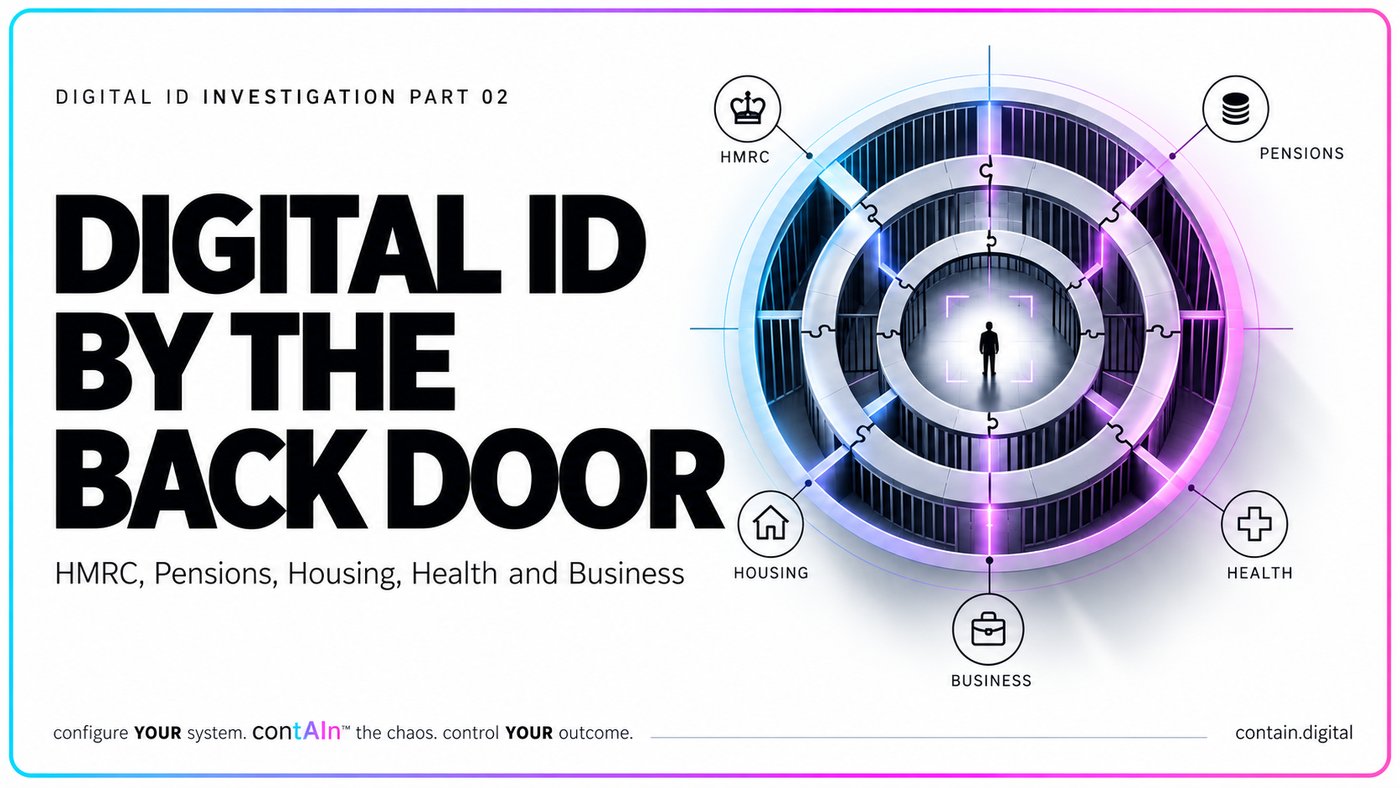
On 9 February 2026, HMRC began moving new customers onto GOV.UK One Login. People registering for HMRC’s digital services without an existing Government Gateway account were directed towards the new sign-in system, part of a wider programme intended eventually to replace separate Government logins. [1]
That might sound like an administrative change, but consider what HMRC actually does. It deals with our taxes, income records and financial obligations, we cannot simply decide we no longer wish to deal with it.
Other services already using GOV.UK One Login: State Pensions and benefits, applying for Personal Independence Payment, dealing with Companies House, signing electronic mortgage deeds and using lasting powers of attorney. [2]
These are not obscure technology experiments, they concern income, housing, business ownership and the ability to act for someone who needs help managing their affairs.
Each service has its own requirements, and joining One Login does not mean every transaction requires biometric identity verification, but the direction of travel is unmistakable. More interactions with Government are moving towards a shared digital sign-in and identity-verification infrastructure.
So what happens to people who cannot, or do not wish to, use it?
That topic became considerably more interesting on 19 October 2026, when senior officials appeared before the House of Commons Public Accounts Committee to explain what was happening to digital identity after the Government publicly cancelled its national Digital ID programme. [3]
During the session, Rupert Lowe MP warned that “we will end up getting digital ID by the back door rather than the front door.” [3]
Which Government services already use One Login?
The public-facing One Login directory lists 61 services, although officials told Parliament that 245 services had joined the programme. A later figure of 264 was also mentioned during the hearing, without the difference being clearly reconciled. [2][3]
The published directory does not explain the full operational reach of those larger numbers.
HMRC is particularly significant. Existing Government Gateway users are being migrated in stages. HMRC has clearly said that its intention is eventually to replace Government Gateway with One Login, but people should continue using their existing credentials until instructed otherwise. [1]
For businesses, Companies House has already introduced mandatory identity verification for directors and people with significant control, with implementation deadlines depending on individual circumstances. This can be completed through One Login or an authorised corporate service provider. [4]
However, the supposed offline alternative still involves the digital portal.
Government guidance explains that someone choosing to verify their identity at a Post Office must first enter their identity-document details online, obtain a customer letter and attend the branch. Afterwards, they receive an email directing them back to One Login to retrieve the outcome and their Companies House personal code. [5]
The Post Office provides an in-person identity check, but the process is not independent of the online system. There are other authorised verification routes, but describing a digitally dependent process as an alternative to digital verification obscures the point.
What did Parliament reveal about the infrastructure?
The national Digital ID programme was publicly cancelled, but the underlying services were not.
At the hearing on Monday, Christine Bellamy described continuing work on One Login, Government digital credentials, GOV.UK Wallet and what officials called joined-up services. That last component concerns the ability to recognise an individual consistently across Government departments. She acknowledged that the intended capability was not yet operational. [3]
Natalie Jones told the committee that One Login is “not a big data lake” and that “One Login does not issue a single identifier to people.” Not yet, at least: the joined-up work Christine Bellamy described exists to “see an individual as one person across Government”. [3]
The testimony then moved beyond Government services.
Natalie Jones also explained that testing was under way to allow certified private-sector verification providers to interact with Government-issued digital credentials. In December 2026, further end-to-end testing is planned, involving a digital driving licence held in GOV.UK Wallet and its verification by private businesses. Officials described a proposed national rollout beginning in 2027. [3] The obvious question here is how long until they are connected?
The Government has identified more than 80 types of evidence for its digital wallet roadmap, including proof of benefits and Disclosure and Barring Service certificates. These are proposed additions, not 80 credentials already available to the public. [3]
This is where the wider question becomes difficult to dismiss.
A Government credential might begin as a convenient replacement for a document, but once systems are designed to allow businesses to verify those credentials, the potential range of applications expands.
Shops, landlords, employers and online services each have legitimate reasons for checking certain facts about customers or applicants. That does not establish that they should be able to demand any credential they choose, nor that refusal should prevent participation.
We have encountered the underlying principle before. In December 2021, England required qualifying COVID-status certification for access to nightclubs and certain large events. Those requirements were temporary, allowed different forms of evidence and ended in January 2022. [6]
Those events very clearly demonstrated how access to social activity could be made conditional on presenting an approved credential. That does not mean GOV.UK Wallet is a social-credit system. No evidence from the parliamentary hearing establishes a system that scores people according to their behaviour, but it doesn’t rule it out either.
What it means is that we should examine the conditions under which identity and eligibility verification might become necessary, who has authority to establish those conditions, and whether people have genuine alternatives.
What happens if you cannot prove your identity digitally?
The committee heard two figures that deserve scrutiny.
Officials estimated that approximately 9% of the population cannot readily prove their identity through conventional passport or driving-licence routes. Christine Bellamy described a broader figure of around 20% experiencing difficulties with digital services, including problems involving digital skills, language and acting on someone else’s behalf. [3]
They also said knowledge-based verification questions using DWP benefits data have already been introduced, that open banking will follow next year, and estimated that about 85% of the 9% without photo ID have a bank account. [3]
Such changes may improve access for people currently excluded by identification requirements, but they also introduce further questions about which personal information is used, the legal basis for its use, and what happens when a record is incorrect.
A person who needs to manage their pension, register a company or complete a legal obligation cannot always postpone the task because an identity system does not recognise them.
Officials assured MPs that alternative routes would remain available, including help at a Post Office, and said that services must demonstrate an alternative route before going live with One Login. [3] Yet help completing a digital process is not necessarily the same as an independent non-digital alternative.
I examined a related problem in When Did The UK Public Agree to This? [7], looking at public-sector data infrastructure, supplier dependency and the timing of public engagement.
The same question applies here. At what point does a series of individually authorised decisions create an infrastructure that ordinary people cannot realistically avoid?
What does AI have to do with digital identity?
At the hearing, officials discussed the growing challenge of distinguishing humans from automated agents interacting with services. [3]
AI can process large volumes of information, identify patterns, compare biometric data and support automated decisions. Digital identity systems can provide mechanisms for establishing who someone is, or what attributes they can demonstrate.
Those capabilities are distinct, but they are not unconnected, as the Government develops reusable credentials and considers more joined-up public services, more becomes technically and operationally possible as information can be accessed, verified and processed across systems.
Who authorises those uses? Who determines whether automated conclusions are accurate? Who can challenge an incorrect outcome, and does that person have access to a human with authority to change it?
These questions also arise in Is the UK Building Digital ID by the Back Door? [8], which I published on Monday October 19 2026.
The underlying principle is the same whether the organisation is a Government department, employer or technology company: the ability to automate a process does not settle whether that process is necessary, proportionate or properly controlled.
Why did the parliamentary evidence receive so little attention?
The original national Digital ID announcement in September 2025 [9] attracted substantial national reporting. The parliamentary evidence on 19 October 2026 was covered by specialist outlets including Computer Weekly and The Register, but my searches found less dedicated coverage of the hearing across major general-news publications.
That is in and of itself an important question, given that the hearing concerned infrastructure potentially affecting almost everyone in the UK, most of whom do not follow parliamentary committees or specialist technology journalism.
We have seen this before. During the pandemic, according to a Ministry of Defence answer to Parliament, “77th Brigade supported the national response to the COVID-19 pandemic and provided support to the Department for Culture, Media, and Sport, who were working to counter disinformation.” [10]
Big Brother Watch, drawing on subject access requests, reported that soldiers collated tweets from British citizens about Covid-19 and passed them to the Cabinet Office, and that the Government’s Counter Disinformation Unit used its relationship with social media companies to recommend the removal of content. [11]
The same department now oversees GOV.UK One Login and the Green Paper on which news should be made easier to find.
This connects to another Government consultation I examined earlier this year. [12]
The Department for Culture, Media and Sport’s Green Paper, Watch this space: a new strategic direction for UK media, proposes that social-media platforms could be required to make trustworthy news providers easily discoverable. [13]
The Government says it has not yet determined the criteria for deciding which news providers would qualify. [13]
Teaching people to examine evidence, understand sources and challenge claims is different from designing a system in which certain news receives preferential distribution.
Those two developments raise related questions about information, access and authority.
One concerns the conditions under which people can establish identity or eligibility. The other concerns who may influence which information receives greater visibility.
Both deserve public scrutiny before the consequences become embedded in everyday systems.
Who is examining the whole picture?
In May, I wrote One Login To Rule Us All. One Login to Bind Us. [14], examining the Government’s developing digital identity architecture and the distinction between a nominally voluntary system and one that may become difficult to avoid in practice.
The October parliamentary hearing adds something important to that earlier discussion, although none of it establishes that Britain already has a compulsory, universal digital identity system.
For somebody trying to complete a tax return, manage a pension, verify a company directorship or sign a mortgage deed, the question is more immediate than the political terminology.
Can they complete the task? What information must they provide? What happens when verification fails? Is there a usable alternative, and who is accountable for the outcome?
The question I keep circling is whether the public has had a meaningful opportunity to examine what those components amount to together, particularly when access to essential services is increasingly dependent on how identity is established.
If the national scheme has been cancelled but the infrastructure continues, what exactly has the public been told and why is none of this front-page news?
References
[1] HM Revenue and Customs, HMRC introduces GOV.UK One Login for new customers, 9 February 2026. www.gov.uk/government/news/hmrc-introducesgovukonelogin-for-new-customers and Accessing HMRC online services using GOV.UK One Login, 9 February 2026. www.gov.uk/guidance/accessing-hmrc-online-services-using-govuk-one-login
[2] Government Digital Service, Services using GOV.UK One Login, accessed 21 October 2026. home.account.gov.uk/services-using-one-login
[3] House of Commons Public Accounts Committee, Oral evidence: Digital ID, HC 99, 19 October 2026, Q12, Q26, Q37, Q40, Q41, Q44, Q45, Q62 and Q73 to Q75. committees.parliament.uk/oralevidence/18142/html
[4] Companies House, When you need to verify your identity for Companies House. www.gov.uk/guidance/when-you-need-to-verify-your-identity-for-companies-house
[5] Companies House, How to prove your identity for Companies House at the Post Office, updated 22 September 2026. www.gov.uk/guidance/how-to-prove-your-identity-for-companies-house-at-the-post-office
[6] Department of Health and Social Care, England returns to Plan A as regulations on face coverings and COVID Passes change today, 27 January 2022. www.gov.uk/government/news/england-returns-to-plan-a-as-regulations-on-face-coverings-and-covid-passes-change-today
[7] Samantha Maeer, When Did The UK Public Agree to This?, contain.digital, 15 August 2026. contain.digital/blog/when-did-the-uk-public-agree-to-this
[8] Samantha Maeer, Is the UK Building Digital ID by the Back Door?, contain.digital, 19 October 2026. contain.digital/blog/is-the-uk-building-digital-id-by-the-back-door
[9] Prime Minister’s Office, New digital ID scheme to be rolled out across UK, 26 September 2025. www.gov.uk/government/news/new-digital-id-scheme-to-be-rolled-out-across-uk
[10] Ministry of Defence, answer to written question 135142 on 77th Brigade, answered by James Heappey MP, 14 February 2023. questions-statements.parliament.uk/written-questions/detail/2023-01-30/135142
[11] Big Brother Watch, Inside Whitehall’s Ministry of Truth: how secretive anti-misinformation teams conducted mass political monitoring, 29 January 2023. bigbrotherwatch.org.uk/press-releases/inside-whitehalls-ministry-of-truth-how-secretive-anti-misinformation-teams-conducted-mass-political-monitoring
[12] Samantha Maeer, Who decides which news you are allowed to see?, contain.digital, 27 July 2026. contain.digital/blog/who-decides-which-news
[13] Department for Culture, Media and Sport, Watch this space: a new strategic direction for UK media, green paper and public consultation, 23 June 2026. www.gov.uk/government/consultations/watch-this-space-a-new-strategic-direction-for-uk-media-green-paper-and-public-consultation
[14] Samantha Maeer, One Login To Rule Us All. One Login to Bind Us., contain.digital, 14 May 2026. contain.digital/blog/one-login-to-rule-us-all